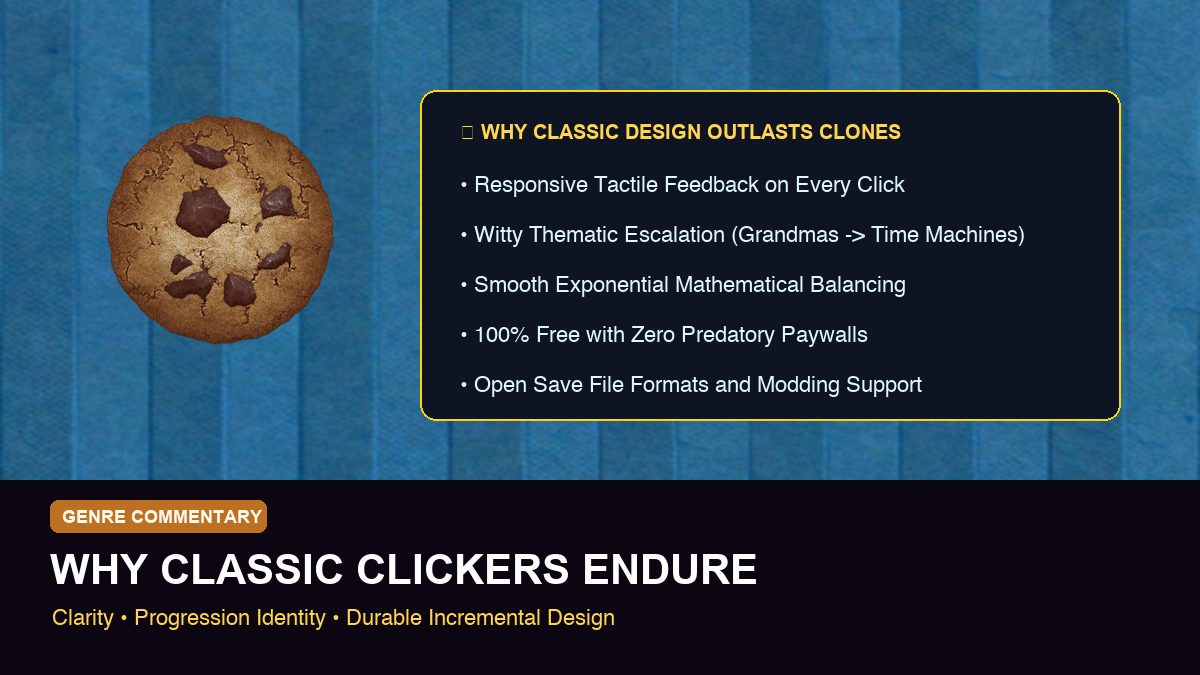
The browser game landscape is flooded with thousands of clicker clones. Yet despite the influx of new titles with flashy 3D graphics or gimmick mechanics, the classic 2013 Cookie Clicker and its polished successors continue to dominate player engagement.
Why do classic clickers retain their magnetic appeal while modern clones fade into obscurity within days? The answer lies in foundational game design: clarity, progression rhythm, and memorable thematic identity.
1. Flawless Mechanical Clarity and Immediate Feedback
A great clicker game teaches its entire premise in two seconds: you see a giant cookie, you click it, a number goes up, and a store item unlocks. The tactile click sound, the floating '+1' particle, and the immediate visual response make the action instantly satisfying.
Many generic clones clutter the screen with intrusive pop-up ads, confusing multi-currency systems, and convoluted menus before the player has even developed an emotional connection with the core loop. Classic clickers prioritize crisp, uncompromised mechanical clarity.
2. Thematic Progression Identity vs Generic Number Inflation
Anyone can write a script that multiplies a number by 1.15x every few seconds. What makes Cookie Clicker immortal is its brilliant, escalating thematic identity: hiring nice grandmas, building cookie farms, digging chocolate mines, founding cookie banks, summoning wizard spells, transmuting gold in alchemy labs, opening portals to the Cookieverse, and building Time Machines to retrieve cookies before they were ever eaten.
This witty, absurd progression narrative makes every new building tier exciting to unlock. Clones that replace these charming concepts with generic '+1% DPS' stat blocks lack the soul that keeps players hooked for months.
- Memorable thematic escalation that delights and surprises players.
- Carefully calibrated mathematical curves that avoid sudden dead zones.
- Gradual introduction of advanced layers (Golden Cookies, Milk, Minigames, Ascension).
- Zero predatory paywalls or aggressive monetization.
3. The Art of Layered Complexity
Classic clickers master the art of progressive disclosure. Day 1 is about clicking and buying grandmas. Week 1 introduces Golden Cookie combos and milk scaling. Month 1 opens up Sugar Lump minigames, dragon training, and multi-tiered prestige trees.
By keeping the onboarding simple while hiding massive strategic depth beneath the surface, classic clickers satisfy both casual tap players and hardcore spreadsheet optimizers.
4. The Longevity of Community-Focused Design
Games that endure are built with genuine affection for the player's experience. Cookie Clicker's generous design—where offline progress is respected, seasonal holiday events rotate throughout the year, and save files are open and exportable—builds deep player loyalty that superficial clones can never replicate.
5. Pacing Curves and Avoiding Mathematical Plateaus
Poorly tuned clones often trap players in weeks of stagnant grinding. Cookie Clicker overcomes plateaus by introducing complementary systems: when building costs become steep, Golden Cookie combos and Heavenly prestige multipliers offer fresh avenues of exponential acceleration.
6. Summary of Classic Design Principles
The enduring success of classic clickers proves that elegant mathematical tuning, witty visual themes, and respect for player time will always triumph over superficial visual polish.
7. The Physics of the 'Perfect Click' Feedback
Classic Cookie Clicker spent months perfecting the tactile feedback of clicking: the cookie scales down smoothly on click, floating numbers drift with gentle physics, and chime tones adjust pitch dynamically during rapid click bursts.
This responsive tactile polish makes clicking physically enjoyable in a way that rigid, laggy clones fail to replicate.
8. Ethical Game Design and Zero Paywalls
Classic clickers were created as labors of love for internet culture, completely free of predatory microtransactions, stamina paywalls, or forced video ads. This pure, generous design philosophy builds authentic player trust that keeps the community thriving 13+ years later.
Respecting player time and delivering transparent, open-source mechanics creates a loyal player base that clones can never buy with marketing.
9. The Timeless Balance of Simple Inputs and Deep Horizons
Ultimately, classic clickers succeed because they understand human psychology: simple, satisfying physical inputs linked to astronomical mathematical scaling. By keeping the initial interaction as effortless as a single mouse click while building toward deep cosmic scale, classic clickers remain the gold standard of incremental game design.
Frequently Asked Questions
What makes Cookie Clicker the best incremental game?
Its perfect combination of immediate responsive feedback, witty progression themes, deep mathematical synergies, and zero pay-to-win mechanics.
Are all newer clicker games bad?
Not at all! New games that introduce fresh mechanics (like Wildfire's fire simulation or Scritchy Scratchy's tactile scratching) are fantastic. It is only uninspired asset-flips that fall flat.
Ready to test your strategy?
Jump into Cookie Clicker 2 in your browser. Apply these upgrade routes, Golden Cookie combos, and ascension timings directly in the live game.
Verified Sources & References
Official Cookie Clicker Steam page
Used as the strongest official public anchor for Cookie Clicker's lasting feature depth and identity.
https://store.steampowered.com/app/1454400/Cookie_Clicker/
Cookie Clicker 2 Cookie Clicker page
Used for the site's current presentation of the classic Cookie Clicker entry.
https://cookie-clicker2.org/play/cookie-clicker-game
Related Guides
View allCookie Clicker Ascension Guide: When to Ascend and What to Buy First
A practical Cookie Clicker ascension guide for first ascension timing, Heavenly Chips, prestige levels, and early permanent upgrade choices.
Cookie Clicker Golden Cookie Guide: Frenzy, Lucky, and Combos
A practical Cookie Clicker Golden Cookie guide covering Frenzy, Lucky, Click Frenzy, Dragonflight, Get Lucky, and combo windows.